
Britain's social care crisis has reached breaking point, and the political establishment's decades-long refusal to confront this demographic reality is about to deliver the most expensive policy failure in modern British history.
The numbers are stark and undeniable. Over 13,000 hospital beds — roughly equivalent to 20 major hospitals — are occupied by patients medically fit for discharge but trapped because adequate social care simply doesn't exist. The NHS spends £2.5 billion annually housing people who should be receiving care elsewhere, whilst 1.6 million elderly people struggle without the support they need at home. Meanwhile, families face the cruel lottery of catastrophic care costs, with residential fees averaging £35,000 per year and dementia care reaching £60,000 annually in many regions.
The Political Cowardice That Created This Crisis
Successive governments have treated social care like a political hand grenade — too dangerous to handle, too important to ignore. Labour promised reform for thirteen years and delivered nothing. The Conservatives pledged a solution in 2010, 2015, 2017, and 2019, yet here we stand with a system more broken than ever. Even Boris Johnson's much-vaunted Health and Social Care Levy — a rare attempt at honest funding — was abandoned by Liz Truss and never properly replaced.
This isn't policy failure; it's moral cowardice dressed up as political pragmatism. Every year of delay makes the eventual reckoning more expensive and the human cost more devastating.
The current system represents the worst of all worlds: a quasi-nationalised model that socialises costs whilst privatising blame. Local councils, starved of funding and overwhelmed by demand, ration care to breaking point. Private providers, squeezed between rising costs and frozen fees, close homes or reduce standards. Families discover that a lifetime of tax payments buys them precisely nothing when they need care most, whilst those who saved responsibly are penalised and those who didn't are protected.
The Conservative Case for Reform
The lazy left-wing response — throw more taxpayer money at the problem — fundamentally misunderstands both the scale of the challenge and the principles at stake. With an ageing population set to grow by 40% over the next two decades, no amount of state spending can possibly meet unlimited demand for free care. Germany's long-term care insurance model, introduced in 1995, offers a blueprint based on conservative principles: personal responsibility, social insurance, and market provision working in harmony.
Under such a system, every working person would contribute to a ring-fenced social care insurance fund, building entitlement to support in old age whilst maintaining incentives to save and plan ahead. Private insurance markets would flourish, offering top-up coverage for those who want better accommodation or additional services. Care providers would compete on quality and efficiency rather than survive on the goodwill of cash-strapped councils.
This approach respects the fundamental conservative principle that individuals should take responsibility for their own futures whilst ensuring that catastrophic costs don't destroy families who've done everything right. It's neither the American nightmare of pure market provision nor the Soviet fantasy of unlimited state care — it's a pragmatic model that works.
Confronting the Opposition
Critics will claim that any insurance-based system represents a 'tax on ageing' or abandons the NHS principle of free-at-the-point-of-use. This argument crumbles under scrutiny. Social care was never part of the NHS founding vision — Aneurin Bevan explicitly excluded it — and the current system already charges users through means-testing that's more brutal than any insurance premium. At least insurance provides certainty and builds genuine entitlement rather than leaving families to discover their liability only when crisis strikes.
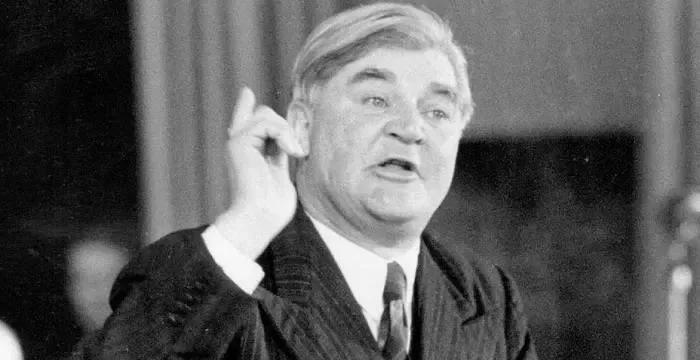 Photo: Aneurin Bevan, via files.famousbio.net
The more honest objection is political: voters have been promised something for nothing for so long that telling the truth about costs seems impossible. Yet this patronising assumption underestimates British pragmatism. Polling consistently shows that voters understand the need for reform and would accept higher contributions in exchange for guaranteed protection. What they won't forgive is continued political dishonesty whilst their parents languish in hospital corridors or their inheritance vanishes into care home fees.
The Price of Delay
Every month of inaction makes the eventual solution more expensive and more painful. Hospital bed-blocking costs are rising by £200 million annually. Care home closures are accelerating, reducing capacity just as demand peaks. Most damaging of all, public trust in the system's fairness continues to erode, making future reform harder to achieve.
The demographic mathematics are unforgiving: today's 45-year-olds will face care needs in an economy where four workers support each pensioner rather than today's ratio of six to one. Without reform, social care will consume an ever-larger share of national resources whilst delivering worse outcomes for those who need it most.
Beyond the Political Comfort Zone
Solving social care requires the kind of long-term thinking that modern politics actively discourages. It means telling voters uncomfortable truths about costs, challenging vested interests in the care sector, and building cross-party consensus around principles rather than partisan point-scoring.
Yet the alternative — continued drift towards system collapse — serves nobody's interests except politicians desperate to avoid difficult decisions. Conservative principles of personal responsibility, market efficiency, and honest government all point towards the same conclusion: Britain needs a properly funded, insurance-based care system that protects families whilst maintaining incentives for individual planning and saving.
The social care crisis isn't just about elderly people stuck in hospital beds or families facing bankruptcy — it's about whether Britain can still make the hard choices necessary for national renewal in the face of demographic change.